


Hartford v. J.R. Marketing: When Insurers Can Recover Cumis Fees
Introduction
Hartford v. J.R. Marketing stands as a key decision clarifying when insurers may recover fees paid to independent counsel under California Civil Code section 2860. When a conflict of interest arises between an insurer and its insured during litigation, section 2860 requires the insurer to provide independent counsel — commonly called Cumis counsel after the seminal case San Diego Navy Federal Credit Union v. Cumis Insurance Society. The insurer pays for this counsel, but the question of whether those fees can later be recovered from the insured or another party has generated significant litigation.
The case arose from a coverage dispute in which Hartford paid for independent counsel to defend its insured, then sought to recover those fees after the underlying matter resolved. The court examined the statutory language of Civil Code section 2860, the nature of the conflict that triggered the independent counsel requirement, and whether the insured had properly waived its right to select that counsel. The decision provides a framework for insurers evaluating whether to pursue fee recovery and for understanding the limits of that recovery right.
For carriers managing block billing and narrative detail standards, the Hartford v. J.R. Marketing decision intersects with billing compliance in a practical way: independent counsel invoices must still meet carrier guidelines, even though the counsel serves the insured's interests rather than the insurer's. The insurer retains the right to review and challenge billing entries that violate outside counsel guidelines and UTBMS activity codes, and the statutory duty of cooperation under section 2860 supports that review process.
The Hartford court's analysis turned on whether the insured had validly waived its right to select independent counsel. Section 2860, subdivision (e) sets out the exact language an insured must sign to waive that right: a statement acknowledging the right, confirming the insured has considered the matter fully, and authorizing the insurer to select defense counsel. Where the insured signs that statement, the insurer's selection of counsel does not trigger the independent counsel requirement, and the insurer bears no obligation to pay for counsel chosen by the insured. Where no valid waiver exists and a conflict is present, the insurer must pay for independent counsel — and the question becomes whether those fees are recoverable.
Section 2860, subdivision (f) preserves the insured's duty to cooperate with the insurer under the terms of the insurance contract, even when independent counsel is selected. This cooperation duty extends to billing: the insured and independent counsel must disclose all information concerning the action except privileged materials relevant to coverage disputes, and must timely inform and consult with the insurer on all matters relating to the action. That duty supports the insurer's right to review invoices, apply outside counsel guidelines, and challenge entries that do not meet the carrier's billing standards.
How Hartford v. J.R. Marketing Shapes the Cumis Fee Recovery Framework
The Hartford v. J.R. Marketing decision clarifies that an insurer's payment of independent counsel fees does not automatically foreclose recovery. The right to recover depends on the source of the insurer's obligation to pay: if the obligation arose solely from the conflict of interest under section 2860, and the insured did not breach any duty or create the conflict through misrepresentation, recovery is limited. If the insured breached the cooperation duty, misrepresented facts material to coverage, or otherwise caused the insurer to incur fees that would not have been owed under the policy, the insurer may recover those fees as damages for the breach.
The court distinguished between fees the insurer is statutorily required to pay — because a conflict exists and no waiver was signed — and fees the insurer paid due to the insured's misconduct. In the former case, the insurer cannot recover simply because it dislikes the outcome or the cost. In the latter case, the insurer may pursue recovery under contract or tort theories, depending on the nature of the breach. This distinction matters when evaluating whether to pursue a fee recovery action: the insurer must identify a breach or wrongful act by the insured that caused the fees to be incurred, not merely the existence of a conflict that triggered the section 2860 obligation.
A conflict of interest does not exist as to allegations or facts in the litigation for which the insurer denies coverage; however, when an insurer reserves its rights on a given issue and the outcome of that coverage issue can be controlled by counsel first retained by the insurer, a conflict of interest may exist.
For carriers managing panel counsel and outside counsel guidelines, the Hartford v. J.R. Marketing framework reinforces the importance of documenting the conflict, offering the waiver in writing, and preserving the record of billing review. If independent counsel is required, the insurer must still enforce its billing guidelines — tenth-of-an-hour increments, narrative detail sufficient to evaluate the task, and UTBMS task and activity codes that match the work performed. The insured's cooperation duty under subdivision (f) supports that enforcement, and a refusal to comply may itself support a later fee recovery claim.
What Problems Does Hartford v. J.R. Marketing Address?
When a conflict of interest triggers the right to independent counsel under California Civil Code section 2860, the insurer pays the bill but does not control counsel selection. That creates a fee exposure the insurer cannot manage through its panel guidelines, staffing ratios or pre-approval thresholds. The central problem in Hartford v. J.R. Marketing is whether an insurer that has paid Cumis fees can later recover those fees from the insured when the underlying claim resolves in a way that eliminates the conflict retroactively or proves the insurer had no duty to defend in the first place.
The Statutory Framework and the Gap It Leaves
California Civil Code section 2860, subdivision (a) states that when a conflict of interest arises, the insurer shall provide independent counsel to represent the insured unless the insured waives that right in writing. The statute does not address what happens to the fees already paid if the facts later show the conflict never materialized or the insurer owed no defence duty. Subdivision (b) clarifies that a conflict does not exist as to allegations for which the insurer denies coverage, but it does not resolve the recovery question when the insurer pays under a reservation of rights and the coverage issue is decided in the insurer's favour after the defence is complete.
The gap matters because Cumis counsel bills are often higher than panel counsel rates, block billing is less constrained, and the insurer has no contractual relationship with the attorney. If the insurer cannot recover those fees, it bears the full cost even when a court ultimately finds no coverage or no conflict. If the insurer can recover, the insured faces a bill years after the defence concluded, often without the funds or the leverage to negotiate.
Timing, Reservation of Rights and the Fee Liability
An insurer that reserves rights on a coverage issue and appoints independent counsel under section 2860 pays the invoices as they arrive. The reservation letter typically states that the insurer is defending under a reservation and that it may seek reimbursement if coverage is denied. The insured selects counsel, and that counsel submits invoices to the carrier, usually through an e-billing portal. The carrier pays, but the legal question—whether the claim is covered—remains open until the underlying case settles or a court rules on a coverage declaratory action.
If the coverage dispute resolves in the insurer's favour, the insurer has paid defence costs for a claim it never had a duty to defend. The question Hartford v. J.R. Marketing addresses is whether that payment, made under a reservation of rights and statutory compulsion, can be recovered from the insured. The answer turns on whether the fee obligation under section 2860 is conditional or absolute, and whether the insurer's payment was made under a mistake of fact or law that permits restitution.
The insurer pays Cumis fees monthly while the coverage question remains unresolved, creating a growing liability that may or may not be recoverable depending on how the coverage issue is ultimately decided.
The Insured's Position and the Practical Burden
From the insured's perspective, the appointment of independent counsel under section 2860 is a statutory right, not a loan. The insured did not choose to be sued, did not create the conflict, and relied on the insurer's defence obligation as stated in the policy. When the insurer later seeks to recover the fees, the insured argues that the statute imposed the duty to pay and that the insurer cannot convert that duty into a conditional advance simply by including reservation language in a letter. The insured may no longer have the funds to reimburse the insurer, especially if the underlying claim was dismissed or settled without the insured contributing.
The practical burden falls hardest on smaller insureds and those without ongoing business relationships with the carrier. A large corporate insured may negotiate a resolution or offset future premiums; an individual or a small business faces a collection action. That disparity shapes how aggressively insurers pursue reimbursement and how often insureds settle for a fraction of the claimed amount rather than litigate the recovery issue in a separate proceeding.
How Can Insurers Recover Cumis Fees After Hartford v. J.R. Marketing?
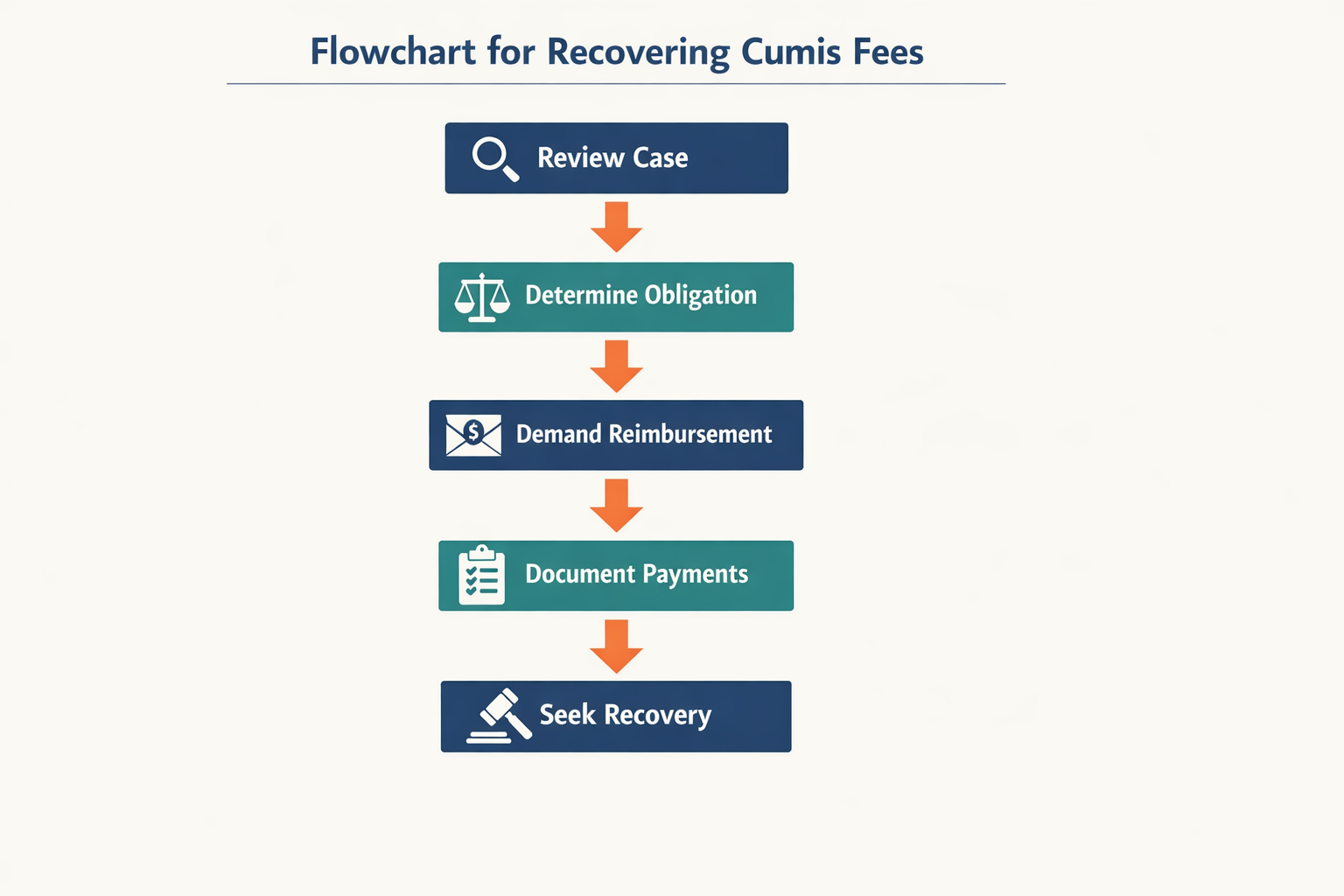
Recovering Cumis fees requires insurers to follow a structured approach grounded in Civil Code section 2860 and the lessons of Hartford v. J.R. Marketing. The steps below outline the procedural path from conflict identification through fee recovery.
Identify the Conflict of Interest Triggering Section 2860
Step 1
Document the conflict
Cal. Civ. Code § 2860, subd. (a) imposes the duty to provide independent counsel when a conflict of interest arises. The insurer must document the specific conflict in writing — for example, a reservation of rights where counsel's conduct of the defense could affect coverage on a reserved issue. Subdivision (b) clarifies that no conflict exists as to allegations for which the insurer denies coverage, and none exists solely because the insured is sued for an amount exceeding policy limits. The conflict must be real, not hypothetical.
Step 2
Notify the insured and offer independent counsel
Once a conflict is identified, the insurer must inform the insured in writing that a conflict exists and that the insured has the right to select independent counsel. The insurer may propose a method of selecting counsel consistent with section 2860, subd. (a), if the policy contains such a provision. The insured may waive the right to select counsel by signing the statement set forth in subdivision (e), authorizing the insurer to choose defense counsel. Document the insured's response — waiver or selection — in the claim file.
Manage Independent Counsel and Maintain Cooperation
Step 3
Ensure dual participation and information exchange
Cal. Civ. Code § 2860, subd. (f) requires that both the insurer's counsel and the independent counsel selected by the insured participate in all aspects of the litigation. The insurer must facilitate full cooperation in the exchange of information, consistent with each counsel's ethical obligations to the insured. Subdivision (d) imposes a reciprocal duty: independent counsel and the insured must disclose to the insurer all non-privileged information concerning the action and consult with the insurer on all matters relating to the action. Any privilege claim is subject to in camera review. The insurer should establish a protocol for regular status updates, discovery sharing, and joint strategy discussions.
Document Fee Arrangements and Invoice Submission
Step 4
Establish reasonable fee terms at the outset
Section 2860 does not prescribe a fee rate for independent counsel, but the insurer remains obligated to pay reasonable fees. The insurer should propose a fee arrangement in writing when independent counsel is retained, referencing the insurer's outside counsel guidelines, billing increments, and narrative detail requirements. If the insured's selected counsel objects to the proposed rate or terms, the insurer must evaluate whether the objection is reasonable and document the resolution. Fee disputes are less common when the insurer states its expectations clearly before the first invoice is submitted.
Step 5
Review invoices under the same standards as panel counsel
Independent counsel invoices should be reviewed for compliance with the same outside counsel guidelines that apply to panel counsel: tenth-of-an-hour increments, prohibition on block billing, and narrative detail sufficient to identify the task and its necessity. The insurer may not impose stricter standards on independent counsel solely because the insured selected them. When an invoice is reduced, the insurer must issue a reduction code and a written explanation that the insured and independent counsel can review and appeal.
Preserve the Record for Recovery
The insurer's ability to recover Cumis fees in a coverage action or declaratory relief proceeding depends on a complete record showing that the fees were incurred under section 2860, that they were reasonable, and that they were paid. The insurer should retain the conflict notification, the insured's waiver or counsel selection, the fee arrangement, all invoices and reductions, and correspondence documenting cooperation between the insurer and independent counsel. That record becomes the foundation for any later claim that the fees are recoverable as defense costs.
Tips and Tricks for Navigating Cumis Fees
Civil Code section 2860 gives insurers the right to recover reasonable fees from independent counsel, but the statute does not define what makes a fee reasonable or how to enforce that right when counsel submits bills that exceed customary rates. The practical challenge is not proving that a conflict exists — that determination triggers the duty to pay independent counsel in the first place — but rather ensuring that the fees paid for that independent representation remain within the bounds the statute contemplates.
Document the Conflict and the Selection Process Early
Section 2860, subdivision (a), requires the insurer to inform the insured when a conflict arises and to provide independent counsel unless the insured waives that right in writing. The moment that notice goes out, the insurer should document the factual basis for the conflict, the date of disclosure, and the method by which independent counsel was selected. If the insured chose counsel from a list the insurer provided, retain the list and the insured's written selection. If the insured selected counsel independently, confirm that selection in writing and note whether the insurer objected or approved the choice. These records become the foundation for any later fee dispute, because they establish that the arrangement was proper under subdivision (a) and that the insurer acted in good faith from the outset.
Establish Rate Expectations Before the First Invoice
Section 2860 does not prescribe a fee schedule, but it also does not require the insurer to pay whatever rate independent counsel demands. Before independent counsel begins work, the insurer should communicate in writing the rates it considers reasonable for the jurisdiction, the nature of the case, and the experience level of the timekeepers. If the insurer has outside counsel guidelines that specify billing increments, narrative detail standards, or prohibitions on block billing, provide those guidelines to independent counsel at the same time. The goal is not to dictate counsel's strategy or control the defense — subdivision (f) makes clear that independent counsel participates in all aspects of the litigation — but to set billing expectations that align with what the insurer would pay panel counsel for comparable work.
If independent counsel objects to the proposed rates, document that objection and the insurer's response. The insurer may choose to pay the higher rate to avoid delaying the defense, but that choice should be memorialized so that the record reflects the insurer's position if the fee issue is later reviewed by a court or in declaratory relief proceedings.
Monitor Invoices for Compliance with Section 2860, Subdivision (d)
Subdivision (d) imposes a duty on independent counsel and the insured to disclose all information concerning the action to the insurer, except privileged materials relevant to coverage disputes, and to inform and consult with the insurer on all matters relating to the action. This disclosure obligation extends to billing: independent counsel should provide invoices with sufficient narrative detail that the insurer can assess the work performed, the time spent, and the relationship of that work to the defense. When an invoice arrives with vague or aggregated entries, the insurer has grounds under subdivision (d) to request clarification before paying the line item.
The insurer should treat each invoice as it would a submission from panel counsel. Apply the same reduction codes, the same narrative sufficiency standards, and the same increment rules. If a line item reads "research and draft motion in limine, 4.2" without specifying the legal issue or the motion's subject, that entry lacks the detail subdivision (d) contemplates. Request a breakdown. If independent counsel asserts privilege over the additional detail, the insurer may seek in camera review under the procedure subdivision (d) authorizes, though that step is rarely necessary for routine billing clarifications.
It shall be the duty of that counsel and the insured to disclose to the insurer all information concerning the action except privileged materials relevant to coverage disputes, and timely to inform and consult with the insurer on all matters relating to the action.
Preserve the Right to Challenge Fees Without Waiving the Conflict Determination
Paying an invoice under protest does not waive the insurer's right to later recover the amount it considers unreasonable, but the insurer must make the protest clear at the time of payment. When the insurer identifies a fee issue — an excessive rate, duplicative time entries, or work that falls outside the scope of the defense — it should pay the amount it deems reasonable and withhold the disputed portion, or pay the full amount and simultaneously send written notice reserving the right to seek reimbursement. The notice should cite the specific line items in dispute, the basis for the objection, and the statute or guideline provision the insurer believes the entry violates.
This practice parallels the reservation-of-rights letter the insurer sends when coverage is uncertain. Just as reserving rights on coverage does not breach the duty to defend, reserving rights on fee reasonableness does not breach the duty to pay independent counsel. The key is contemporaneous documentation: a reduction applied six months after payment, with no prior notice, is harder to defend than a reduction flagged on the payment stub.
Coordinate Between Independent Counsel and Panel Counsel When Both Are Engaged
Subdivision (f) requires both the insurer-provided counsel and the independent counsel selected by the insured to participate in all aspects of the litigation and to cooperate fully in the exchange of information. When both counsel are working on the same matter, the insurer should monitor for duplicative work. If panel counsel drafts a discovery motion and independent counsel also bills for drafting the same motion, one of those entries is not reasonable. The insurer should request a joint case plan or a staffing allocation that clarifies which counsel is responsible for which tasks, and it should apply that allocation when reviewing invoices.
The insurer's outside counsel guidelines, if provided to both counsel at the outset, serve as the common standard. If the guidelines prohibit billing for travel time at the full hourly rate, that prohibition applies to independent counsel and panel counsel alike. Subdivision (f) does not create a separate, more permissive billing regime for independent counsel; it creates a cooperative framework in which both counsel operate under the same ethical and contractual obligations to the insured and the insurer.
Use Declaratory Relief When Fee Disputes Cannot Be Resolved Informally
When independent counsel refuses to reduce a disputed invoice and the insurer believes the fee is unreasonable, the insurer may seek declaratory relief to establish its obligation under section 2860. The declaratory relief action is not an attack on the insured's choice of counsel or the existence of the conflict; it is a request for the court to determine what fee is reasonable given the work performed, the rates charged, and the standards that apply to similar defense work in the jurisdiction. The insurer should file the action promptly, before the accumulation of unpaid invoices creates a funding crisis that could compromise the defense.
The complaint should attach the invoices, the insurer's outside counsel guidelines if applicable, evidence of prevailing rates for comparable work, and any correspondence in which the insurer raised the fee issue with independent counsel. The goal is to show that the insurer acted reasonably in questioning the fee and that the court's intervention is necessary to resolve a good-faith dispute, not to penalize the insured or interfere with the attorney-client relationship.
Conclusion
Hartford v. J.R. Marketing clarifies the boundaries of an insurer's duty to pay for independent counsel when a conflict of interest arises during the defense of a covered claim. The case underscores that an insurer's obligation to fund Cumis counsel is not absolute — it depends on whether a true conflict exists, whether the insured has waived the right to select independent counsel, and whether the insurer has complied with the procedural requirements of Cal. Civ. Code § 2860. Insurers that document the conflict, offer independent counsel in writing, and secure a valid waiver when the insured declines that offer position themselves to recover fees or avoid disputes over counsel selection.
The practical lesson is straightforward: read the statute, follow its steps, and preserve the record. Section 2860, subd. (a) requires the insurer to inform the insured when a conflict arises and to provide independent counsel unless the insured expressly waives that right in writing. Section 2860, subd. (e) specifies the exact language the waiver must contain. An insurer that skips the notice, omits the waiver form, or accepts an oral waiver has no statutory safe harbor and may face a dispute over fees that could have been avoided with a single signed page. Conversely, an insurer that delivers the notice, tenders the waiver form, and documents the insured's response — whether acceptance or refusal — has a defensible position if the insured later claims entitlement to independent counsel at the insurer's expense.
For those managing block billing and narrative detail standards in California insurance defense, Hartford v. J.R. Marketing is a reminder that procedural compliance and clear documentation are not optional. The case law, the statute, and the carrier guidelines all point in the same direction: write it down, cite the controlling provision, and make the record before the fee dispute arrives. Insurers that treat section 2860 as a checklist rather than a suggestion recover fees more often and litigate fee disputes less often.
FAQ
What is Hartford v. J.R. Marketing?Hartford v. J.R. Marketing is a California case that addresses when an insurer can recover fees paid to independent counsel (Cumis counsel) under Civil Code section 2860 after a conflict of interest arises during litigation.
When does a conflict of interest trigger the right to independent counsel?A conflict arises under section 2860 when the insurer reserves rights on a coverage issue and counsel's conduct of the defense could affect that coverage determination, creating a divergence between the insurer's and insured's interests.
Can an insurer recover Cumis fees if coverage is later denied?Recovery depends on whether the insurer's payment was statutorily required or resulted from the insured's breach. If the insured breached the cooperation duty or misrepresented facts, the insurer may recover fees as damages.
What must an insured do to waive the right to select independent counsel?The insured must sign a written statement under section 2860, subd. (e), acknowledging the right to independent counsel, confirming full consideration of the matter, and authorizing the insurer to select defense counsel.
Do independent counsel invoices need to meet the same billing standards as panel counsel?Yes. Independent counsel must comply with the insurer's outside counsel guidelines, including tenth-of-an-hour increments, narrative detail requirements, and prohibitions on block billing, under the cooperation duty in section 2860, subd. (f).