

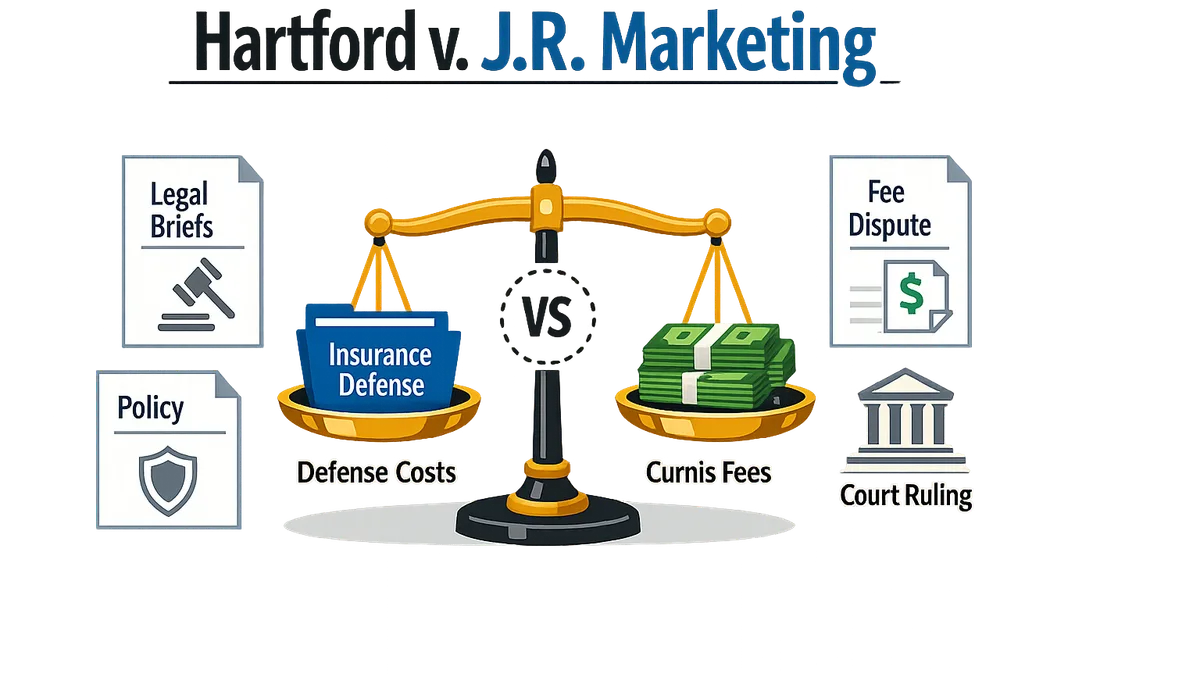
Hartford v. J.R. Marketing: When Insurers Recover Cumis Fees
Introduction
Hartford v. J.R. Marketing is the California Supreme Court decision that clarified when an insurer can recover fees paid to independent Cumis counsel after a conflict of interest resolves or coverage is denied. The case established that the insurer's reimbursement right runs against the insured under the insurance contract, not directly against independent counsel. This ruling reshaped how carriers approach fee recovery in conflict-of-interest defense scenarios and underscored the importance of detailed invoice documentation.
When an insurer reserves rights or a coverage dispute creates a conflict of interest, California law mandates that the insurer provide independent counsel to the insured. That independent counsel, often called Cumis counsel after the San Diego Navy Federal Credit Union v. Cumis Insurance Society decision, represents the insured's interests while the insurer continues to fund the defense. The arrangement protects the insured from counsel whose loyalty is divided, but it also raises a practical question: who ultimately pays for that independent representation when the conflict resolves or coverage is later denied?
Hartford v. J.R. Marketing established the framework for answering that question. The case clarified that an insurer's duty to pay for independent counsel under Civil Code section 2860 is not absolute and permanent. When the conflict that triggered the independent counsel requirement disappears, or when a court later determines that the insurer owed no duty to defend certain claims, the insurer may seek reimbursement from the insured for fees paid on the insured's behalf. This holding matters for billing teams, outside counsel and claims professionals who must track which line items on an invoice relate to covered claims, which relate to excluded claims, and which relate to the conflict itself.
The decision affects how block billing practices are reviewed in the independent counsel context. When an insurer later seeks to recover fees, the narrative detail and task coding in submitted invoices become the evidence that determines which hours are recoverable and which are not. A line item reading "research and draft motion, 4.2" does not tell a reviewing court whether the work addressed a covered claim, an excluded claim, or the conflict that justified independent counsel in the first place.
Understanding Hartford v. J.R. Marketing Cumis Fees Recovery in Insurance Defense
The Hartford v. J.R. Marketing case did not invent the independent counsel requirement. That requirement comes from section 2860, which was enacted in 1987 and codified the Cumis decision. Section 2860, subdivision (b) defines when a conflict exists: a conflict does not exist solely because the insured is sued for an amount exceeding policy limits, and no conflict exists as to allegations for which the insurer denies coverage. However, when an insurer reserves its rights on a coverage issue and the outcome of that issue can be controlled by counsel retained by the insurer, a conflict may exist.
What Hartford v. J.R. Marketing clarified is the fee recovery mechanism. The insurer's duty to pay for independent counsel is tied to the existence of the conflict. Once the conflict disappears, whether through settlement, summary adjudication of the coverage issue, or a final determination that the insurer owed no duty to defend, the insurer is no longer obligated to bear the cost of independent counsel for claims outside its coverage obligations. The insured, who benefited from the representation, becomes responsible for those fees.
This principle reshapes how defense costs are allocated in mixed-claim cases. When a complaint includes both covered and non-covered claims, and a conflict triggers the independent counsel requirement, the insurer initially pays for all defense work. Later, if coverage is denied on certain claims, the insurer can seek reimbursement for the portion of the independent counsel's fees that related to those non-covered claims. The burden falls on the insurer to prove which fees are recoverable, and that proof depends on the detail captured in the invoices submitted during the defense.
Both the counsel provided by the insurer and independent counsel selected by the insured shall be allowed to participate in all aspects of the litigation.
For billing purposes, this means that independent counsel invoices submitted to an insurer must contain sufficient narrative detail and accurate UTBMS task and activity codes to allow later allocation. A carrier reviewing an invoice years after the defense concluded must be able to distinguish time spent defending covered claims from time spent defending non-covered claims, and time spent managing the conflict itself. If the invoice does not support that distinction, the insurer's ability to recover fees is compromised, but so is the insured's ability to defend against an overbroad recovery demand.
What Did Hartford v. J.R. Marketing Address?
Hartford's cross-complaint against Squire Sanders and its insureds presented a straightforward claim: the insurer had paid Cumis counsel fees under a conflict-of-interest reservation and now sought reimbursement for amounts it believed were overbilled. The trial court sustained Squire Sanders's demurrer without leave to amend, concluding that Hartford's right to reimbursement, if any, ran against its insureds, not directly against Cumis counsel. That ruling rested on public policy principles drawn from Jackson v. Rogers & Wells (1989) 210 Cal.App.3d 336, which addresses the non-assignability of legal malpractice claims.
The Insurer's Dilemma
Civil Code section 2860, subdivision (a) requires an insurer to provide independent counsel when a conflict of interest arises, but the statute is silent on reimbursement mechanics when the conflict later dissolves or when counsel's billing exceeds reasonable limits. Hartford argued it could recoup overbilled amounts directly from Cumis counsel. Squire Sanders countered that any reimbursement right belonged to the insureds, who might then pursue indemnity from their former counsel. The trial court sided with Cumis counsel, leaving Hartford to pursue its insureds for amounts it contended were excessive.
Structural Barriers to Direct Recovery
The demurrer asserted that recognizing a reimbursement cause of action against a law firm would produce undesirable consequences. Independent counsel owes fiduciary duties to the insured, not the insurer. Allowing the insurer to sue counsel directly would create a second master, undermining the conflict-free representation that section 2860 mandates. The trial court's ruling reinforced the boundary: the insurer's remedy, if it exists, flows from the insurance contract and must be pursued against the party to that contract.
Carriers managing block billing disputes and narrative-detail standards in panel counsel invoices face analogous problems when independent counsel submit time entries that lack the specificity required under published guidelines. Hartford's inability to recover directly from Cumis counsel means that insurers must enforce billing standards through the insured or accept the fees as paid.
How Do Insurers Recover Cumis Fees After Hartford v. J.R. Marketing?
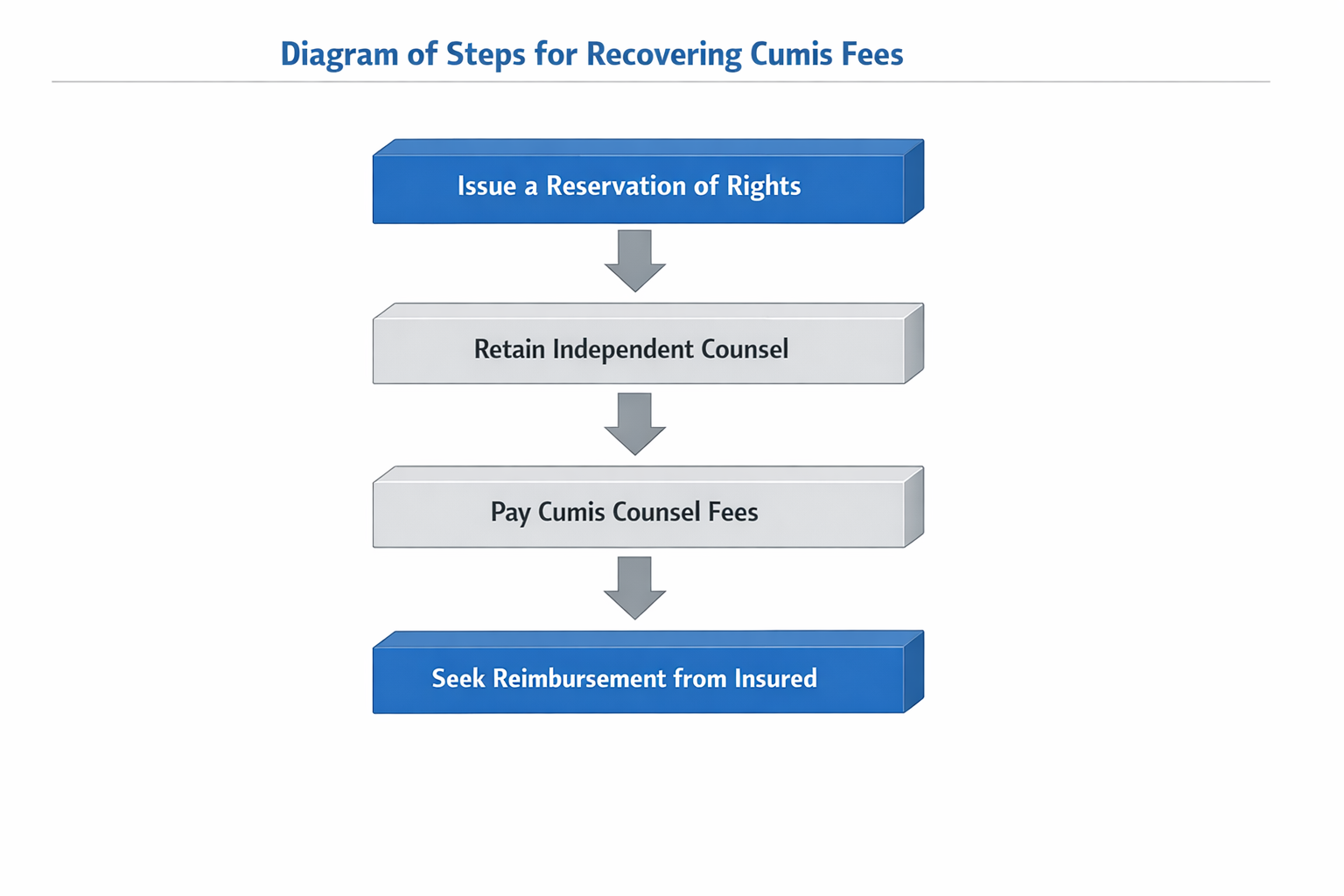
The Hartford v. J.R. Marketing decision established that an insurer's right to recover overbilled Cumis counsel fees runs against the insured, not directly against independent counsel. The court sustained the demurrer to Hartford's reimbursement claim against Squire Sanders, concluding that the insurer's remedy, if any, lies with its insureds under the insurance contract. That holding reshapes how carriers approach fee recovery when a conflict of interest resolves or when billing irregularities surface.
Establish the Duty to Defend and the Conflict Trigger
Step 1
Confirm the duty and the conflict
Before Cumis counsel enters the matter, verify that the policy imposes a duty to defend and that a conflict of interest exists under Cal. Civ. Code § 2860, subd. (b). A conflict arises when the insurer reserves rights on a coverage issue and the outcome of that issue can be controlled by counsel the insurer first retained. The statute specifies that no conflict exists solely because the insured is sued for an amount exceeding policy limits or as to allegations the insurer denies coverage.
In Hartford, the trial court entered a summary adjudication order in July 2006 finding that Hartford had a duty to defend and, because of Hartford's reservation of rights, must fund Cumis counsel. That order triggered the insured's right to select independent counsel and the insurer's obligation to pay reasonable fees.
Document the Billing Relationship and Fee Agreement
Step 2
Memorialize fee terms with the insured
Cal. Civ. Code § 2860, subd. (d) requires independent counsel and the insured to disclose all non-privileged information to the insurer and to inform and consult with the insurer on all matters relating to the action. The insurer pays Cumis counsel's fees, but the attorney-client relationship runs between counsel and the insured. Document the fee arrangement, the billing increment, the narrative detail standard, and the submission protocol in writing before the first invoice.
Carriers that fail to specify billing requirements at the outset face a weaker position when disputing fees later. Outside counsel guidelines that govern panel counsel do not automatically bind independent counsel unless the insured and counsel agree to them in writing.
Monitor Invoices and Flag Irregularities Contemporaneously
Step 3
Review line items as they arrive
Review each invoice for block billing, vague narratives, and charges that exceed the scope of the defense obligation. Common reduction triggers include entries that combine multiple tasks without time breakdowns, charges for coverage analysis or fee disputes, and administrative overhead that the insurer did not pre-approve. When an entry reads "research and draft motion in limine, 4.2," the lack of task separation invites a block-billing reduction under most carrier guidelines and e-billing portal validation rules.
Timely objection preserves the insurer's right to challenge the fee. Silence through multiple billing cycles may estop the insurer from later asserting that the same pattern was unreasonable.
Assert Reimbursement Claims Against the Insured, Not Counsel
Step 4
Pursue recovery through the insurance contract
Hartford v. J.R. Marketing holds that the insurer's reimbursement right, if any, runs against the insured under the insurance contract, not directly against Cumis counsel. The trial court sustained the demurrer to Hartford's cross-complaint against Squire Sanders, reasoning that recognizing a reimbursement cause of action against a law firm would produce undesirable consequences. The insured may then seek indemnity from counsel if the overbilling resulted from counsel's conduct.
Preserve the Insured's Cooperation Duty
Cal. Civ. Code § 2860, subd. (f) provides that nothing in the independent counsel statute relieves the insured of the duty to cooperate with the insurer under the terms of the insurance contract. When pursuing reimbursement, the insurer may invoke the cooperation clause to compel the insured to produce billing records, time entries, and correspondence with Cumis counsel. The insured's failure to cooperate may constitute a material breach that supports a coverage defense or a setoff against the reimbursement claim.
The duty to cooperate survives the resolution of the underlying action. An insurer that waits until after settlement to audit Cumis fees retains the right to demand cooperation in that audit, subject to any waiver or estoppel arising from the insurer's prior conduct.
Tips and Tricks
Navigating Cumis counsel arrangements requires more than understanding the statute — it demands practical discipline in documentation, communication and fee management. The provisions of Civil Code section 2860 create obligations for both the insurer and the insured, and missteps on either side can turn a straightforward defense into a billing dispute that outlasts the underlying claim.
Document the Conflict Before Appointing Counsel
Civil Code section 2860, subdivision (b) defines when a conflict of interest exists: it does not arise solely because the insurer reserves rights, but it may exist when the outcome of a coverage issue can be controlled by counsel first retained by the insurer. Before appointing independent counsel, document the specific facts that create the conflict. A reservation-of-rights letter alone is not sufficient. Identify the coverage issue, explain how defense counsel's strategy could influence that issue, and memorialize the analysis in writing. If the insured later challenges the reasonableness of fees, the insurer must show that the appointment was justified by a genuine conflict, not by the insured's preference or a blanket reservation.
Establish Fee Guidelines and Obtain Written Consent
Civil Code section 2860, subdivision (a) permits the insurance contract to set forth the method of selecting independent counsel. Extend that principle to fee arrangements: establish billing guidelines, increments and narrative standards in writing before the independent counsel submits the first invoice. The insured selects the counsel, but the insurer pays the fees, and the statute does not eliminate the insurer's right to impose reasonable billing standards. Provide the guidelines to both the insured and the appointed counsel, and obtain written acknowledgment. If the insured waives the right to select independent counsel under subdivision (e), document that waiver with the statutory language and a signature.
Require Full Cooperation and Disclosure
Subdivision (d) imposes a duty on independent counsel and the insured to disclose all information concerning the action, except privileged materials relevant to coverage disputes, and to inform and consult with the insurer on all matters relating to the action. Enforce that duty from the first case-status call. Independent counsel is not adversarial counsel — the insurer remains a party to the defense, and subdivision (f) requires both insurer-provided counsel and independent counsel to participate in all aspects of the litigation and cooperate fully in the exchange of information. Set up regular status meetings, require copies of all significant filings and correspondence, and confirm that the independent counsel understands the cooperation obligation. A failure to disclose a settlement demand or a dispositive motion can undermine the insurer's ability to evaluate both the defense and any later fee dispute.
Counsel shall cooperate fully in the exchange of information that is consistent with each counsel's ethical and legal obligation to the insured.
Audit Invoices Against the Same Standards You Apply to Panel Counsel
Independent counsel is not exempt from billing standards. Apply the same invoice review process you use for panel counsel: check for block billing, verify that time entries match the billing increment specified in the guidelines, confirm that UTBMS task and activity codes align with the narrative, and flag any entry that lacks contemporaneous detail. If the independent counsel bills in quarter-hour increments when the guideline specifies tenths, reduce the entry and explain the reduction in writing. If a narrative reads "research and draft motion, 6.8," request an itemized breakdown. The insured's right to select counsel does not override the insurer's right to pay only reasonable fees, and reasonableness includes compliance with the billing standards disclosed at the outset.
Preserve the Record for Any Later Fee Dispute
If the conflict that justified the independent counsel appointment later resolves — because coverage is established, the reservation is withdrawn, or the claim settles within policy limits — the insurer may seek to recover fees paid during the period when no conflict existed. That recovery claim depends entirely on the written record. Retain every invoice, every reduction letter, every status report and every communication in which the insured or the independent counsel was informed of a billing standard or a cooperation obligation. If the insurer later contends that certain fees were unreasonable or that the insured breached the duty to cooperate, the court will ask what the insurer told the insured and when. The answer must be in the file, not reconstructed from memory.
Conclusion
Hartford v. J.R. Marketing settled a recurring question in California insurance defense: when an insurer pays Cumis counsel fees under Civil Code section 2860 and later discovers overbilling, whom can the insurer sue for reimbursement? The California Supreme Court held that an insurer's right to recover runs against its insureds, not directly against independent counsel. The trial court sustained the demurrer to Hartford's cross-complaint against Squire Sanders, concluding that Hartford's right to reimbursement, if any, was from its insureds, not directly from Cumis counsel (61 Cal.4th 988, paragraph 15). The court grounded that conclusion in Buss and public policy against the assignment of legal malpractice actions, reasoning that recognizing a reimbursement cause of action against a law firm would result in undesirable consequences (61 Cal.4th 988, paragraph 14).
The practical effect is straightforward: insurers who suspect that Cumis counsel overbilled must pursue their insureds for reimbursement, and the insureds may then pursue indemnity from counsel if the facts support it. The decision does not foreclose an insurer's right to recover — it channels that right through the party with whom the insurer holds a contract. For carriers reviewing invoices from independent counsel, the ruling underscores the importance of enforcing outside counsel guidelines and narrative detail standards at the time of submission, rather than relying on a direct claim against counsel after the fact.
Understanding the boundaries Hartford drew helps insurers structure their bill review workflows and their relationships with both insureds and independent counsel. Carriers who invest in clear guidelines, timely invoice review, and documented reduction codes reduce the likelihood that a fee dispute will escalate to reimbursement litigation. For more on how carriers enforce billing standards through e-billing portals, see E-Billing Portal Invoice Rejections: Common Causes and Fixes.
FAQ
Can an insurer recover Cumis counsel fees directly from the law firm?No. Hartford v. J.R. Marketing held that the insurer's reimbursement right runs against the insured under the insurance contract, not directly against independent counsel. The trial court sustained the demurrer to Hartford's cross-complaint against Squire Sanders on this basis.
When does an insurer's duty to pay Cumis counsel fees end?The duty ends when the conflict of interest that triggered the independent counsel requirement resolves, or when a court determines that the insurer owed no duty to defend certain claims. At that point, the insurer may seek reimbursement from the insured for fees paid on non-covered claims.
What billing detail is required to support later fee recovery?Invoices must contain sufficient narrative detail and accurate UTBMS task and activity codes to allow allocation between covered claims, non-covered claims, and conflict management. Block billing entries that combine multiple tasks without time breakdowns compromise the insurer's ability to prove which fees are recoverable.
Does Civil Code section 2860 require the insurer to pay unreasonable fees?No. The statute requires the insurer to provide independent counsel when a conflict exists, but it does not eliminate the insurer's right to impose reasonable billing standards. Carriers may enforce outside counsel guidelines, narrative detail requirements, and billing increment standards if disclosed at the outset.
What happens if the insured refuses to cooperate in a fee audit?Cal. Civ. Code § 2860, subdivision (f) provides that nothing in the independent counsel statute relieves the insured of the duty to cooperate with the insurer under the insurance contract. The insured's failure to cooperate may constitute a material breach that supports a coverage defense or a setoff against the reimbursement claim.